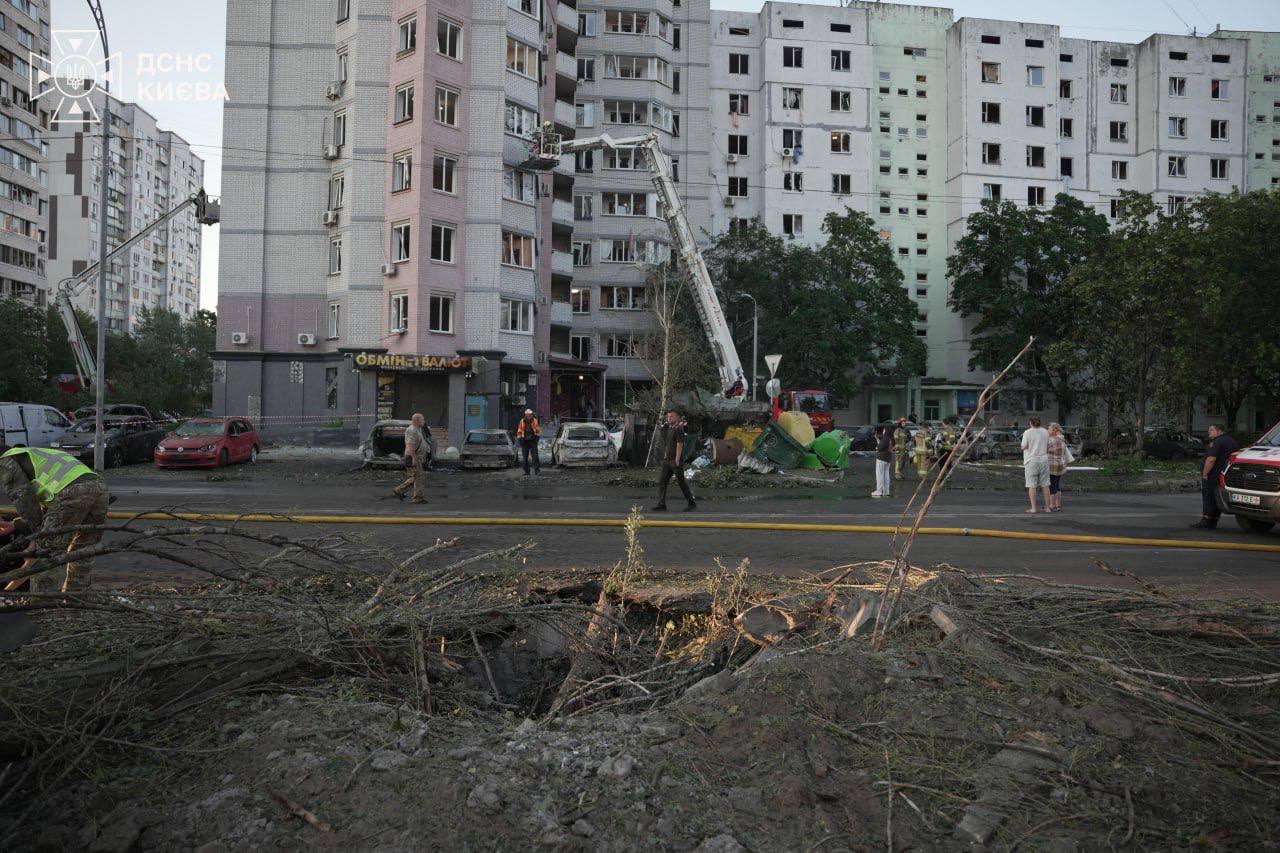
Rescue crews work beside a Kyiv apartment block with its windows blown out after an overnight Russian strike. The image was issued by Ukraine’s State Emergency Service after an attack on 1 August 2026 and is used here as a file photo. Photo: State Emergency Service of Ukraine/Wikimedia Commons (CC BY 4.0)
Listen to this article3 min listenAI voice
Tap play to hear this story
You are listening to Kibra News Network.
Child among three killed in Russian missile attacks near Kyiv.
Overnight strikes hit the Kyiv region as Ukraine warns its supply of missile interceptors is running down.
Russia continued its overnight attacks after President Volodymyr Zelensky warned of Ukraine's dwindling supplies of missile interceptors.
The pattern of overnight strikes
Long-range strikes on Ukrainian cities have followed a recognisable rhythm since the full-scale invasion began in 2022: waves of cruise missiles and one-way attack drones launched overnight, often mixing weapon types and approach routes so that air defences have to divide their attention. Because interceptors are finite and each engagement consumes them, the arithmetic of these attacks is as much about depletion as destruction.
That is why supply of air defence munitions has been one of the most persistent themes in Ukraine's appeals to its partners. Advanced interceptors are produced in limited quantities and take years to manufacture, and shortages force commanders to prioritise which sites are protected, which in practice means some areas are covered and others are not. Civilian casualties in residential districts are the direct consequence of that rationing.
Why it matters in Kenya
Kenya has followed this conflict less for its military course than for its economic reach. Disruption to Black Sea grain and edible oil exports and to fertiliser supply fed directly into Kenyan food and farming costs, and the effects on what households could afford have been documented by researchers working in Nairobi and beyond. Kenya has also, at the United Nations, argued the case from an African perspective about the sanctity of borders inherited at independence.
What to watch next
Casualty figures in the immediate aftermath of strikes are provisional and are routinely revised as rescue work continues. The wider indicators to follow are whether interceptor supply commitments are made by partner governments and whether the tempo of long-range attacks changes in response.
That was a Kibra News Network report, read by an A I voice.
Overnight strikes hit the Kyiv region as Ukraine warns its supply of missile interceptors is running down.
Russia continued its overnight attacks after President Volodymyr Zelensky warned of Ukraine's dwindling supplies of missile interceptors.
The pattern of overnight strikes
Long-range strikes on Ukrainian cities have followed a recognisable rhythm since the full-scale invasion began in 2022: waves of cruise missiles and one-way attack drones launched overnight, often mixing weapon types and approach routes so that air defences have to divide their attention. Because interceptors are finite and each engagement consumes them, the arithmetic of these attacks is as much about depletion as destruction.
That is why supply of air defence munitions has been one of the most persistent themes in Ukraine’s appeals to its partners. Advanced interceptors are produced in limited quantities and take years to manufacture, and shortages force commanders to prioritise which sites are protected, which in practice means some areas are covered and others are not. Civilian casualties in residential districts are the direct consequence of that rationing.
Why it matters in Kenya
Kenya has followed this conflict less for its military course than for its economic reach. Disruption to Black Sea grain and edible oil exports and to fertiliser supply fed directly into Kenyan food and farming costs, and the effects on what households could afford have been documented by researchers working in Nairobi and beyond. Kenya has also, at the United Nations, argued the case from an African perspective about the sanctity of borders inherited at independence.
What to watch next
Casualty figures in the immediate aftermath of strikes are provisional and are routinely revised as rescue work continues. The wider indicators to follow are whether interceptor supply commitments are made by partner governments and whether the tempo of long-range attacks changes in response.