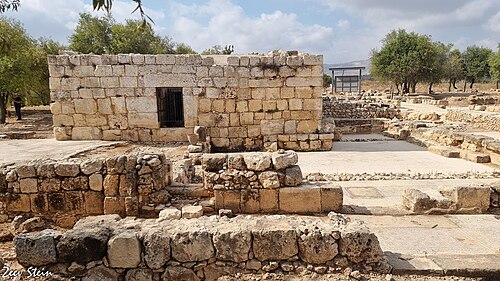
The ancient Shiloh archaeological site in the occupied West Bank. File photo, illustrative. Photo: זאב שטיין / Wikimedia Commons (CC BY 2.5)
Listen to this article2 min listenAI voice
Tap play to hear this story
You are listening to Kibra News Network.
Israel accused of weaponising archaeology at ancient West Bank sites.
Israel is planning large-scale land expropriations in historic, Palestinian areas of the West Bank.
Background
The West Bank has been under Israeli occupation since 1967, and under international humanitarian law an occupying power's authority over cultural property is limited to protection and maintenance rather than permanent change. Archaeology in the territory has long been contested, because excavation and heritage designation carry a claim about who belongs to a place, and because declaring land an antiquities site or a national park restricts building, grazing and farming rights for the people living around it. Most of the disputed sites sit in Area C, the roughly 60 per cent of the West Bank under full Israeli civil and security control.
Why it matters here
Kenyan readers meet the same argument in a different register. Heritage listing, conservation designation and public-interest expropriation are all instruments that decide who may build, farm or remain on a piece of land, and in Kenya they have repeatedly collided with the claims of long-settled residents. In Nairobi, and in Kibra in particular, the question of whose occupation is treated as historically legitimate and whose is treated as encroachment has shaped every attempt at upgrading, road widening and resettlement.
What to watch next
Whether the expropriations are formally gazetted, whether they are challenged in the Israeli courts or before international bodies, and whether professional archaeological associations take a position on the excavation work itself.
This story was put together by K N N from material first published by BBC News.
That was a Kibra News Network report, read by an A I voice.
Israel is planning large-scale land expropriations in historic, Palestinian areas of the West Bank.
Background
The West Bank has been under Israeli occupation since 1967, and under international humanitarian law an occupying power’s authority over cultural property is limited to protection and maintenance rather than permanent change. Archaeology in the territory has long been contested, because excavation and heritage designation carry a claim about who belongs to a place, and because declaring land an antiquities site or a national park restricts building, grazing and farming rights for the people living around it. Most of the disputed sites sit in Area C, the roughly 60 per cent of the West Bank under full Israeli civil and security control.
Why it matters here
Kenyan readers meet the same argument in a different register. Heritage listing, conservation designation and public-interest expropriation are all instruments that decide who may build, farm or remain on a piece of land, and in Kenya they have repeatedly collided with the claims of long-settled residents. In Nairobi, and in Kibra in particular, the question of whose occupation is treated as historically legitimate and whose is treated as encroachment has shaped every attempt at upgrading, road widening and resettlement.
What to watch next
Whether the expropriations are formally gazetted, whether they are challenged in the Israeli courts or before international bodies, and whether professional archaeological associations take a position on the excavation work itself.