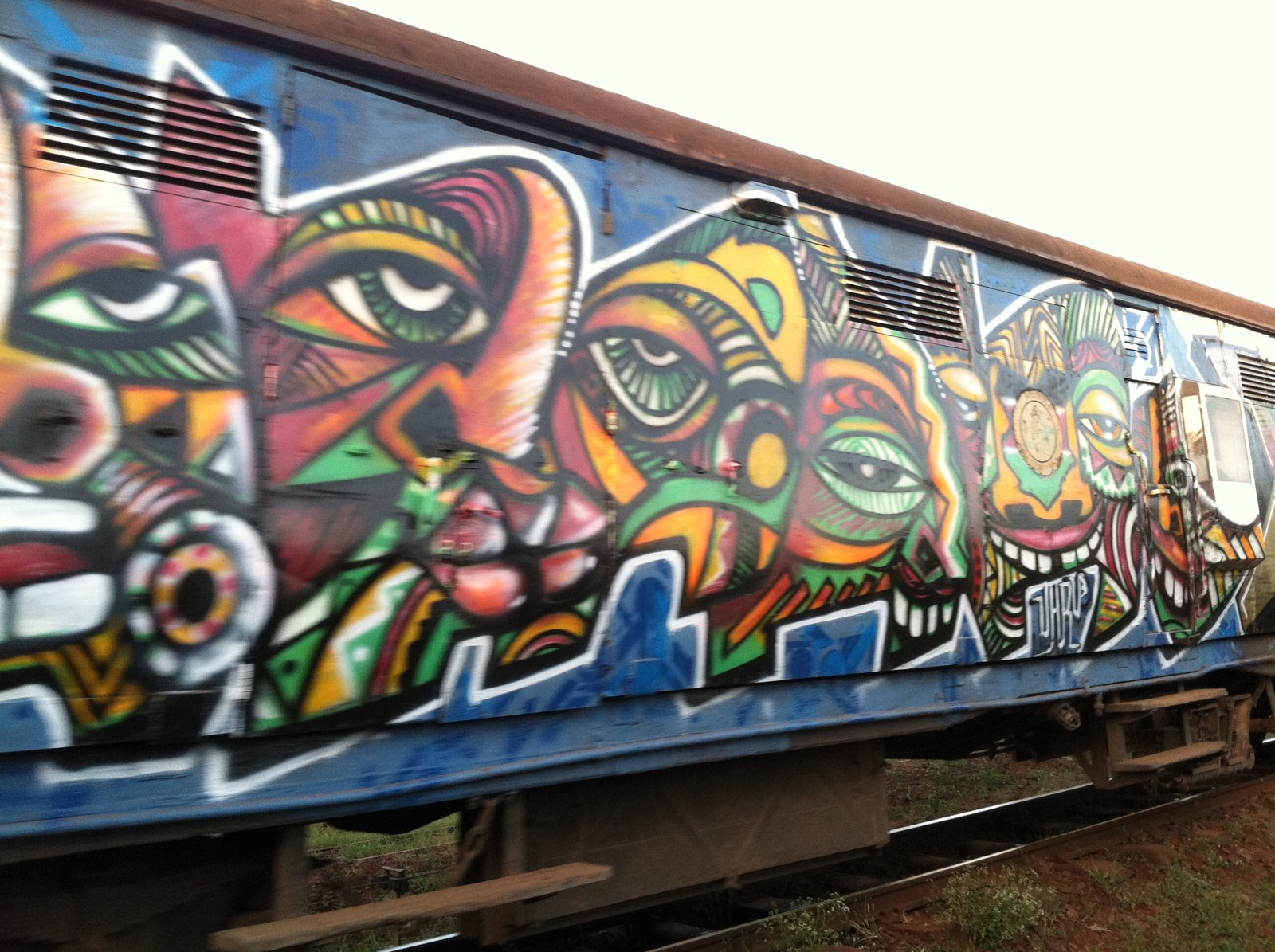
The Peace Train, painted in one night in February 2013. Photo: Joel Bergner / Kibera Walls for Peace
Listen to this article3 min listenAI voice
Tap play to hear this story
You are listening to Kibra News Network.
Kibera Walls for Peace: the 2013 project that painted seven murals and a commuter train.
Kibera Creatives is a KNN series on the artists, designers and performers who built their names from Kibera. Profiles are compiled from published reports and the subjects' own public pages; sources are listed at the end. Spotted an error? Write to news@kibranewsnetwork.co.ke.
Kibera Walls for Peace was a youth public-art project run in the weeks before the 4 March 2013 election. It was led by Brooklyn artist-educator Joel Bergner with the Kibera group Kibera Hamlets, whose director was John Adoli, and organised by Mia Foreman. It was funded by the Open Society Initiative for Eastern Africa and 140 backers on Kickstarter, and ran from January to March 2013.
Seven murals
About 30 young people from Kibera took part in workshops on the roots of violence and on peace-building, then painted seven public murals in the settlement. They included Kabila Langu ni Mkenya (My Tribe is Kenya) and Two Hyenas, in which hyenas in suits stood for corrupt politicians.
One night, ten carriages
With permission from Rift Valley Railways, the youth joined Nairobi graffiti artists, organised by Bankslave and including Swift9, Uhuru B, WiseTwo and Stephen Onyango Owino, to paint a ten-car commuter train that runs through Kibera. They did it in a single night. NPR reported it on 19 February 2013 as possibly Africa's first officially authorised graffiti train. Its main slogan, Tuwache Ukabila, Tuwache Ubaguzi, Tuishi Kwa Amani, came from a poem by a 13-year-old Kibera girl. "I think it's every graffiti artist's dream to paint on a train," Swift9 told NPR.
Nairobi filmmaker Willie Owusu made a documentary about the project, My Tribe is Kenya, and NPR, AFP, the BBC, RFI and Arise TV covered it. Bergner went on to co-found the non-profit Artolution. The murals' exact locations were not recorded in the published reports, and KNN would like to hear from readers who know which still stand.
Sources: Joel Bergner, 27 Jul 2013; Joel Bergner, 6 Feb 2013; NPR, 19 Feb 2013; Wikipedia, Joel Bergner.
That was a Kibra News Network report, read by an A I voice.
Kibera Creatives is a KNN series on the artists, designers and performers who built their names from Kibera. Profiles are compiled from published reports and the subjects’ own public pages; sources are listed at the end. Spotted an error? Write to news@kibranewsnetwork.co.ke.
Kibera Walls for Peace was a youth public-art project run in the weeks before the 4 March 2013 election. It was led by Brooklyn artist-educator Joel Bergner with the Kibera group Kibera Hamlets, whose director was John Adoli, and organised by Mia Foreman. It was funded by the Open Society Initiative for Eastern Africa and 140 backers on Kickstarter, and ran from January to March 2013.
Seven murals
About 30 young people from Kibera took part in workshops on the roots of violence and on peace-building, then painted seven public murals in the settlement. They included Kabila Langu ni Mkenya (My Tribe is Kenya) and Two Hyenas, in which hyenas in suits stood for corrupt politicians.
One night, ten carriages
With permission from Rift Valley Railways, the youth joined Nairobi graffiti artists, organised by Bankslave and including Swift9, Uhuru B, WiseTwo and Stephen Onyango Owino, to paint a ten-car commuter train that runs through Kibera. They did it in a single night. NPR reported it on 19 February 2013 as possibly Africa’s first officially authorised graffiti train. Its main slogan, Tuwache Ukabila, Tuwache Ubaguzi, Tuishi Kwa Amani, came from a poem by a 13-year-old Kibera girl. “I think it’s every graffiti artist’s dream to paint on a train,” Swift9 told NPR.
Nairobi filmmaker Willie Owusu made a documentary about the project, My Tribe is Kenya, and NPR, AFP, the BBC, RFI and Arise TV covered it. Bergner went on to co-found the non-profit Artolution. The murals’ exact locations were not recorded in the published reports, and KNN would like to hear from readers who know which still stand.
KNN Newsroom is the staff byline for stories written, rewritten and edited at the Kibra News Network desk. Where a story credits an outside outlet, the original source is linked at the foot of the piece.