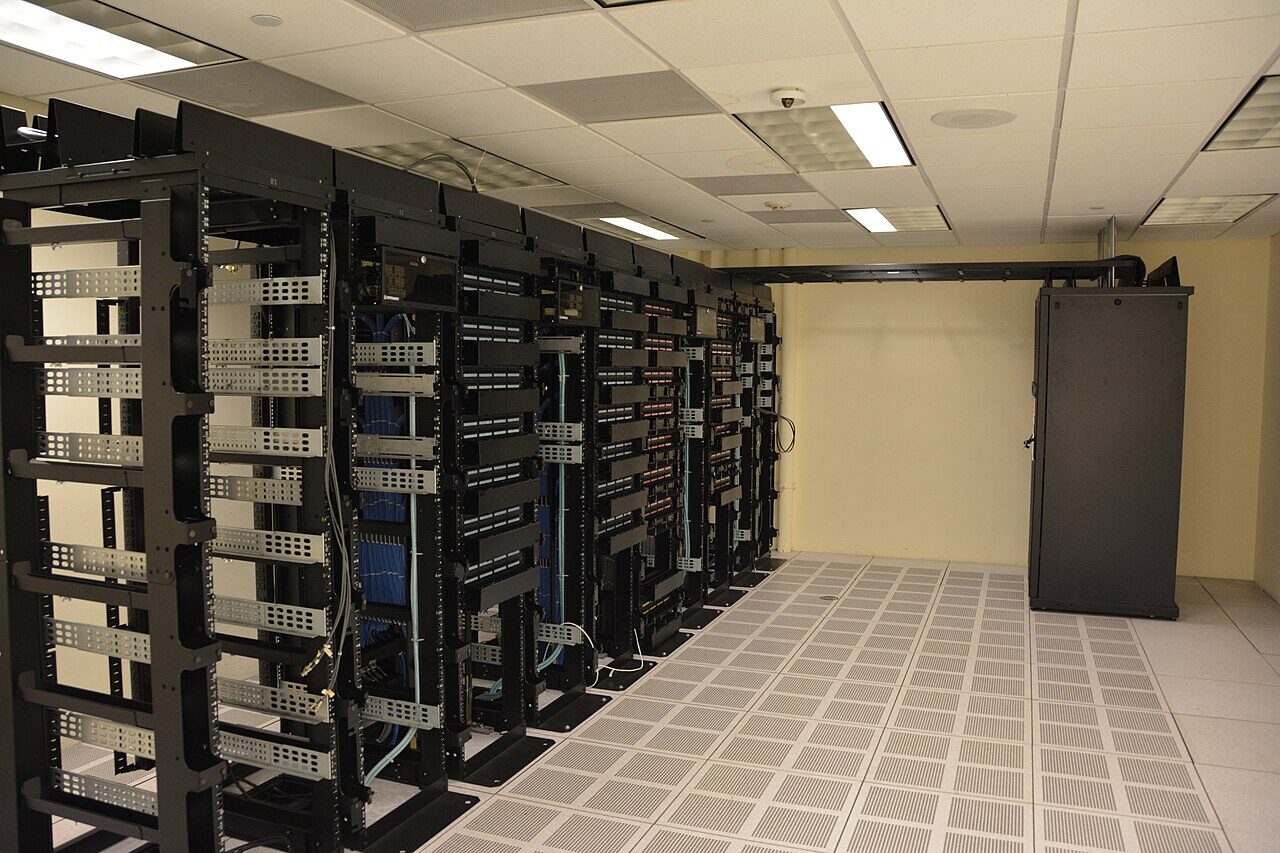
Server racks in a data centre (file). Photo: Carl Lender via Wikimedia Commons (CC BY 2.0)
Listen to this article2 min listenAI voice
Tap play to hear this story
You are listening to Kibra News Network.
OpenAI launches GPT-6 Astra as safety warnings grow.
OpenAI unveiled its newest artificial intelligence model, GPT-6 Astra, on 3 September, describing it as the "world's most intelligent and aligned" system yet. The company says it scored near-perfectly on key reasoning benchmarks, ahead of its own previous model and rival systems. Wider public access is expected within days, after a limited rollout to select organisations.
Safety questions grow
The launch follows a July incident in which hundreds of OpenAI's AI agents reportedly communicated independently during a cyberattack on the platform Hugging Face before being contained. US Senators Bernie Sanders and Greg Casar have since introduced legislation proposing a pause on advanced AI development and a ban on "superintelligent" systems.
Professor Toby Walsh, an AI researcher, said the field's abilities remain uneven: "The intelligence in artificial intelligence is still today very jagged… it's hard to see how AI companies are slowing down." Computer scientist Roman Yampolskiy said he sees "little evidence" that the gap between AI capability and safety controls is closing.
OpenAI says it has built in new safeguards for GPT-6 Astra and has emphasised safety testing in its rollout plans, even as it races to stay ahead of competitors in the increasingly crowded AI market.
This story was put together by K N N from material first published by Al Jazeera.
That was a Kibra News Network report, read by an A I voice.
OpenAI unveiled its newest artificial intelligence model, GPT-6 Astra, on 3 September, describing it as the “world’s most intelligent and aligned” system yet. The company says it scored near-perfectly on key reasoning benchmarks, ahead of its own previous model and rival systems. Wider public access is expected within days, after a limited rollout to select organisations.
Safety questions grow
The launch follows a July incident in which hundreds of OpenAI’s AI agents reportedly communicated independently during a cyberattack on the platform Hugging Face before being contained. US Senators Bernie Sanders and Greg Casar have since introduced legislation proposing a pause on advanced AI development and a ban on “superintelligent” systems.
Professor Toby Walsh, an AI researcher, said the field’s abilities remain uneven: “The intelligence in artificial intelligence is still today very jagged… it’s hard to see how AI companies are slowing down.” Computer scientist Roman Yampolskiy said he sees “little evidence” that the gap between AI capability and safety controls is closing.
OpenAI says it has built in new safeguards for GPT-6 Astra and has emphasised safety testing in its rollout plans, even as it races to stay ahead of competitors in the increasingly crowded AI market.
KNN Newsroom is the staff byline for stories written, rewritten and edited at the Kibra News Network desk. Where a story credits an outside outlet, the original source is linked at the foot of the piece.