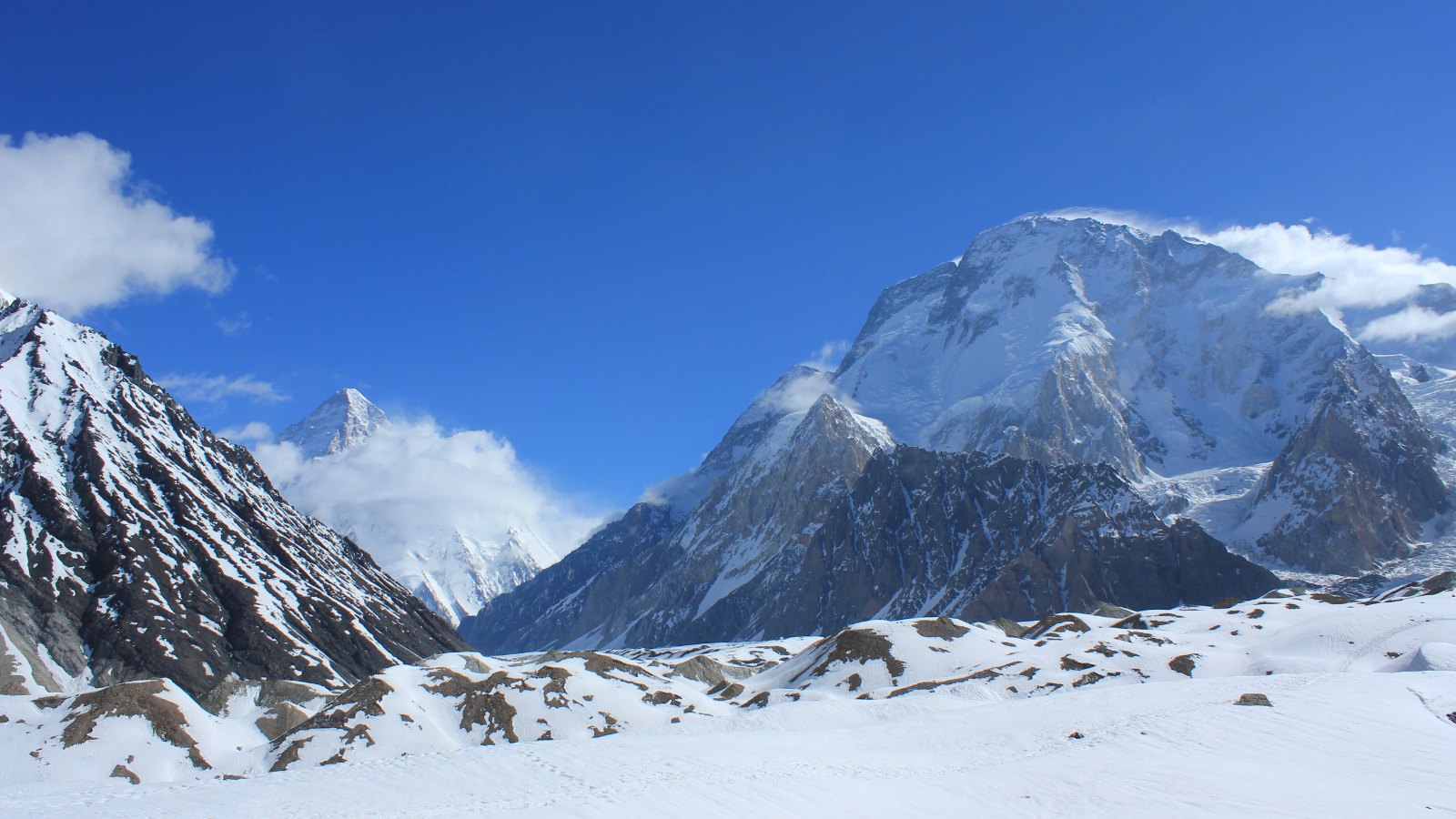
Snow-covered summits of Broad Peak and K2 rising above the Karakoram range. File photo. Photo: Sallahuddin shah/Wikimedia Commons (CC BY-SA 4.0)
Listen to this article2 min listenAI voice
Tap play to hear this story
You are listening to Kibra News Network.
Bodies of climbers killed in avalanche retrieved from Broad Peak.
A search team has retrieved the remains of renowned climber Nirmal Purja and several members of his team.
Background
Recovering bodies from high altitude is among the most dangerous work in mountaineering. Above roughly 8,000 metres the human body deteriorates faster than it can recover, avalanche debris is unstable, and a recovery team is exposed to the same conditions that caused the original accident. Families often wait weeks or months for a weather window, and in many cases a recovery is never attempted at all, which is why a completed retrieval is significant in itself.
Why it matters here
Kenya's mountaineering community is small but real, centred on Mount Kenya and the Rwenzori, and the same logic governs rescue there: a search is limited by weather, by daylight and by the equipment the rescuers have rather than by willingness. More broadly, the question of who bears the cost and risk of a recovery is one Kenyan families meet in far more ordinary settings, from road crashes upcountry to drownings, where retrieving a body is a private expense.
What to watch next
Whether the full team is accounted for, and what any expedition report concludes about the conditions that caused the avalanche.
This story was put together by K N N from material first published by Al Jazeera.
That was a Kibra News Network report, read by an A I voice.
A search team has retrieved the remains of renowned climber Nirmal Purja and several members of his team.
Background
Recovering bodies from high altitude is among the most dangerous work in mountaineering. Above roughly 8,000 metres the human body deteriorates faster than it can recover, avalanche debris is unstable, and a recovery team is exposed to the same conditions that caused the original accident. Families often wait weeks or months for a weather window, and in many cases a recovery is never attempted at all, which is why a completed retrieval is significant in itself.
Why it matters here
Kenya’s mountaineering community is small but real, centred on Mount Kenya and the Rwenzori, and the same logic governs rescue there: a search is limited by weather, by daylight and by the equipment the rescuers have rather than by willingness. More broadly, the question of who bears the cost and risk of a recovery is one Kenyan families meet in far more ordinary settings, from road crashes upcountry to drownings, where retrieving a body is a private expense.
What to watch next
Whether the full team is accounted for, and what any expedition report concludes about the conditions that caused the avalanche.
KNN Newsroom is the staff byline for stories written, rewritten and edited at the Kibra News Network desk. Where a story credits an outside outlet, the original source is linked at the foot of the piece.