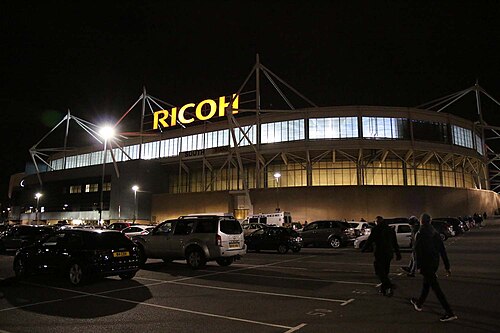
The football stadium in Coventry, England. File photo, illustrative. Photo: Steve Daniels / Wikimedia Commons (CC BY-SA 2.0)
Listen to this article2 min listenAI voice
Tap play to hear this story
You are listening to Kibra News Network.
Coventry sign Ghana’s Yirenkyi for record fee.
Premier League newcomers Coventry City have completed the club-record signing of Ghana midfielder Caleb Yirenkyi.
Background
Ghana has been one of the most consistent suppliers of midfielders to European leagues for three decades, and a club-record fee for a Ghanaian player reflects both that pipeline and the money now available to newly promoted English clubs. Deals of this kind trigger a set of mechanisms that matter more than the headline number: training compensation and solidarity payments are due to the clubs that developed the player between the ages of 12 and 23, which for African players usually means an academy at home.
Why it matters here
Kenya has the players and almost none of the machinery. Very few Kenyan clubs are structured to receive solidarity payments, academy registration is patchy, and the result is that when a Kenyan player does move abroad, the money largely bypasses the people who trained him. KNN has reported on the same gap in Kibra, where clubs such as Kibera Black Stars develop players with no realistic mechanism for capturing value if one of them succeeds.
What to watch next
Whether the registration and work permit complete without difficulty, when he makes his debut, and whether the developing clubs in Ghana receive the solidarity share the transfer generates.
This story was put together by K N N from material first published by BBC News.
That was a Kibra News Network report, read by an A I voice.
Premier League newcomers Coventry City have completed the club-record signing of Ghana midfielder Caleb Yirenkyi.
Background
Ghana has been one of the most consistent suppliers of midfielders to European leagues for three decades, and a club-record fee for a Ghanaian player reflects both that pipeline and the money now available to newly promoted English clubs. Deals of this kind trigger a set of mechanisms that matter more than the headline number: training compensation and solidarity payments are due to the clubs that developed the player between the ages of 12 and 23, which for African players usually means an academy at home.
Why it matters here
Kenya has the players and almost none of the machinery. Very few Kenyan clubs are structured to receive solidarity payments, academy registration is patchy, and the result is that when a Kenyan player does move abroad, the money largely bypasses the people who trained him. KNN has reported on the same gap in Kibra, where clubs such as Kibera Black Stars develop players with no realistic mechanism for capturing value if one of them succeeds.
What to watch next
Whether the registration and work permit complete without difficulty, when he makes his debut, and whether the developing clubs in Ghana receive the solidarity share the transfer generates.
KNN Newsroom is the staff byline for stories written, rewritten and edited at the Kibra News Network desk. Where a story credits an outside outlet, the original source is linked at the foot of the piece.