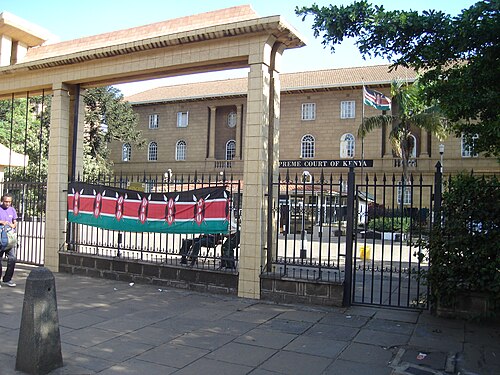
The Supreme Court of Kenya building in Nairobi. File photo, illustrative. Photo: Kriddl / Wikimedia Commons (CC0)
Listen to this article2 min listenAI voice
Tap play to hear this story
You are listening to Kibra News Network.
2027 election: Kenya must resolve the constitutional clock before crisis.
A commentary argues that Kenya needs to settle the constitutional question of when the 2027 general election falls before the uncertainty becomes a crisis, according to the source credited below.
Background
The Constitution fixes the general election on the second Tuesday of August in the fifth year, but it does not spell out unambiguously when that fifth year begins, and Kenya has now produced more than one judicial answer to the question. The practical risk in leaving it unresolved is not legal untidiness. The electoral commission works backwards from the polling date to set the deadlines for voter registration, boundary review, party primaries, procurement of materials and the recruitment of temporary staff, and each of those has a statutory minimum period. A date settled late compresses every one of them at once.
Why it matters here
For voters in Kibra the compression lands in the most basic parts of the process: whether the registration centre opens in time for people turning eighteen, whether the ward boundaries used are the reviewed ones, and whether polling stations in dense areas are adequately staffed. Kibra has a history of long queues and contested tallying, both of which get worse when the commission is working to a schedule it did not have time to plan.
What to watch next
Whether the question reaches the Supreme Court, whether Parliament attempts to legislate a clarification, and what date the electoral commission publishes in its own timetable.
This story was put together by K N N from material first published by People Daily.
That was a Kibra News Network report, read by an A I voice.
A commentary argues that Kenya needs to settle the constitutional question of when the 2027 general election falls before the uncertainty becomes a crisis, according to the source credited below.
Background
The Constitution fixes the general election on the second Tuesday of August in the fifth year, but it does not spell out unambiguously when that fifth year begins, and Kenya has now produced more than one judicial answer to the question. The practical risk in leaving it unresolved is not legal untidiness. The electoral commission works backwards from the polling date to set the deadlines for voter registration, boundary review, party primaries, procurement of materials and the recruitment of temporary staff, and each of those has a statutory minimum period. A date settled late compresses every one of them at once.
Why it matters here
For voters in Kibra the compression lands in the most basic parts of the process: whether the registration centre opens in time for people turning eighteen, whether the ward boundaries used are the reviewed ones, and whether polling stations in dense areas are adequately staffed. Kibra has a history of long queues and contested tallying, both of which get worse when the commission is working to a schedule it did not have time to plan.
What to watch next
Whether the question reaches the Supreme Court, whether Parliament attempts to legislate a clarification, and what date the electoral commission publishes in its own timetable.
KNN Newsroom is the staff byline for stories written, rewritten and edited at the Kibra News Network desk. Where a story credits an outside outlet, the original source is linked at the foot of the piece.