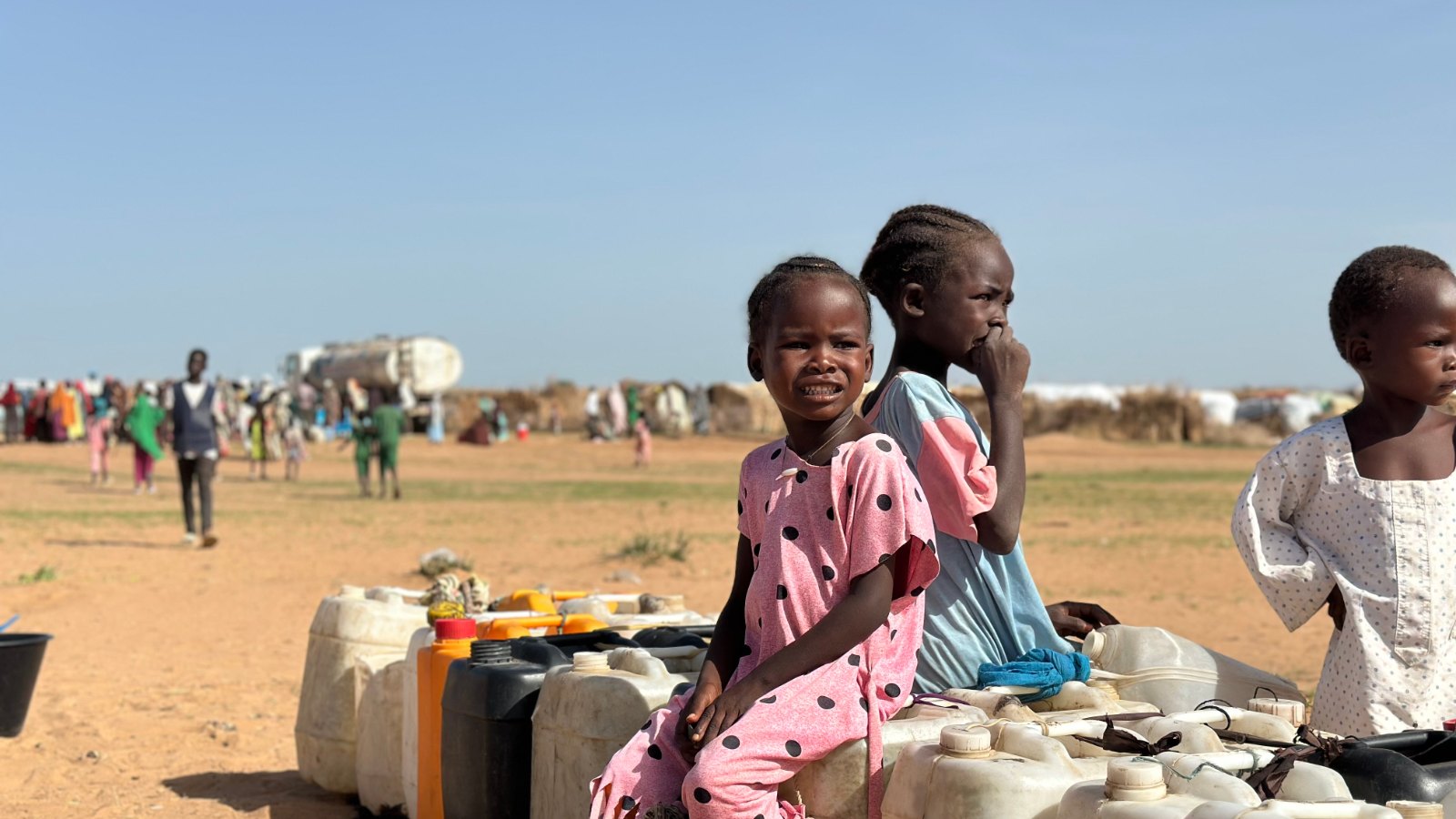
Children wait with jerrycans at a water point in a displacement camp near El Fasher. Aid groups say Sudan’s war has left a generation of children unregistered and unseen. Photo: Ahmed 222222/Wikimedia Commons (CC0)
Listen to this article2 min listenAI voice
Tap play to hear this story
You are listening to Kibra News Network.
Sudan’s invisible children.
Babies born as a result of rape are often unable to get a birth certificate, meaning a life-time of problems.
Background
Legal identity is the gateway to everything else. Without a birth certificate a child cannot ordinarily be enrolled in school, registered for health cover, or issued with identity documents as an adult, and the effects compound over a lifetime. In conflict settings the registration system is often the first thing to break, and children born in circumstances that carry stigma are the least likely to be registered at all, because registration usually requires a parent to present themselves to an official and answer questions about the father.
Why it matters here
Kenya has its own registration gap, and it is concentrated in exactly the households that can least absorb the consequences. Late registration requires affidavits and fees, children born at home or to very young mothers are more likely to go unregistered, and in Kibra the missing certificate typically surfaces years later when a child cannot sit an examination or open a mobile money account. The Kenyan version is administrative rather than the product of war, but the outcome for the child is similar.
What to watch next
Whether humanitarian agencies are able to run registration in the affected areas, and whether any pathway to late registration is created for these children.
This story was put together by K N N from material first published by born in war with no legal identity.
That was a Kibra News Network report, read by an A I voice.
Babies born as a result of rape are often unable to get a birth certificate, meaning a life-time of problems.
Background
Legal identity is the gateway to everything else. Without a birth certificate a child cannot ordinarily be enrolled in school, registered for health cover, or issued with identity documents as an adult, and the effects compound over a lifetime. In conflict settings the registration system is often the first thing to break, and children born in circumstances that carry stigma are the least likely to be registered at all, because registration usually requires a parent to present themselves to an official and answer questions about the father.
Why it matters here
Kenya has its own registration gap, and it is concentrated in exactly the households that can least absorb the consequences. Late registration requires affidavits and fees, children born at home or to very young mothers are more likely to go unregistered, and in Kibra the missing certificate typically surfaces years later when a child cannot sit an examination or open a mobile money account. The Kenyan version is administrative rather than the product of war, but the outcome for the child is similar.
What to watch next
Whether humanitarian agencies are able to run registration in the affected areas, and whether any pathway to late registration is created for these children.
KNN Newsroom is the staff byline for stories written, rewritten and edited at the Kibra News Network desk. Where a story credits an outside outlet, the original source is linked at the foot of the piece.