Photo: Mikhail Nilov / Pexels, file photo, cropped. Logos: Africa CDC and WHO.
Listen to this article3 min listenAI voice
Tap play to hear this story
You are listening to Kibra News Network.
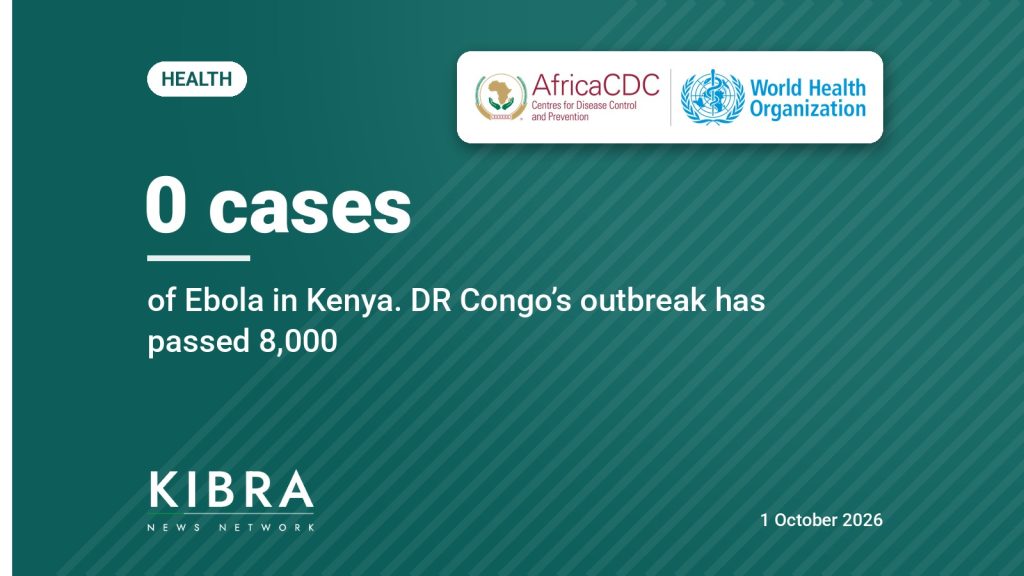
Ebola: Kenya is on Africa CDC’s list of 10 countries at risk as DR Congo’s outbreak passes 8,000 cases. There are no cases in Kenya.
Africa CDC, the African Union's public health agency, has named Kenya among 10 countries at risk from the Ebola outbreak in the Democratic Republic of Congo (DRC). Kenya has no confirmed cases.
The other countries on the list are Rwanda, Tanzania, Angola, Burundi, the Central African Republic, Congo-Brazzaville, Ethiopia, South Sudan and Zambia.
The outbreak
As of 30 September, the European Centre for Disease Prevention and Control counted 8,116 confirmed cases and 3,924 deaths in DRC, across 63 health zones in seven provinces.
It is the Bundibugyo strain of Ebola, for which there is no approved vaccine. About half of confirmed cases have died.
It has spread to two new areas: Dungu, near the South Sudan border, and Bulu, near the Central African Republic border.
Uganda's outbreak, with 20 cases, was declared over on 25 August.
The World Health Organization rates the risk as very high in DRC, high for neighbouring countries, and low for the rest of Africa. It advises against limits on travel or trade.
What Kenya is doing
Kenya has stepped up checks at its border points and airports. In mid-September, health officials said the country had four laboratories able to test for Ebola: the National Public Health Laboratory, KEMRI in Nairobi, KEMRI in Kisumu, and a mobile lab serving Busia and Bungoma. All suspected cases tested so far have been negative.
What it means for you
There is no Ebola in Kenya. Be wary of social media posts that claim otherwise, and check with the Ministry of Health.
Ebola spreads through direct contact with the blood or body fluids of a person who is sick with it, or who has died from it. It does not spread through the air like flu.
If someone has a sudden fever with bleeding, or a fever after recent travel to DR Congo, go to the nearest health facility and tell the staff about the travel.
Sources: The Standard (Africa CDC list), ECDC (case numbers), WHO (risk), Al Jazeera (spread), (Kenya's labs).
That was a Kibra News Network report, read by an A I voice.
Africa CDC, the African Union’s public health agency, has named Kenya among 10 countries at risk from the Ebola outbreak in the Democratic Republic of Congo (DRC). Kenya has no confirmed cases.
The other countries on the list are Rwanda, Tanzania, Angola, Burundi, the Central African Republic, Congo-Brazzaville, Ethiopia, South Sudan and Zambia.
Graphic: Kibra News Network
The outbreak
As of 30 September, the European Centre for Disease Prevention and Control counted 8,116 confirmed cases and 3,924 deaths in DRC, across 63 health zones in seven provinces.
It is the Bundibugyo strain of Ebola, for which there is no approved vaccine. About half of confirmed cases have died.
It has spread to two new areas: Dungu, near the South Sudan border, and Bulu, near the Central African Republic border.
Uganda’s outbreak, with 20 cases, was declared over on 25 August.
The World Health Organization rates the risk as very high in DRC, high for neighbouring countries, and low for the rest of Africa. It advises against limits on travel or trade.
What Kenya is doing
Kenya has stepped up checks at its border points and airports. In mid-September, health officials said the country had four laboratories able to test for Ebola: the National Public Health Laboratory, KEMRI in Nairobi, KEMRI in Kisumu, and a mobile lab serving Busia and Bungoma. All suspected cases tested so far have been negative.
What it means for you
There is no Ebola in Kenya. Be wary of social media posts that claim otherwise, and check with the Ministry of Health.
Ebola spreads through direct contact with the blood or body fluids of a person who is sick with it, or who has died from it. It does not spread through the air like flu.
If someone has a sudden fever with bleeding, or a fever after recent travel to DR Congo, go to the nearest health facility and tell the staff about the travel.
KNN Newsroom is the staff byline for stories written, rewritten and edited at the Kibra News Network desk. Where a story credits an outside outlet, the original source is linked at the foot of the piece.