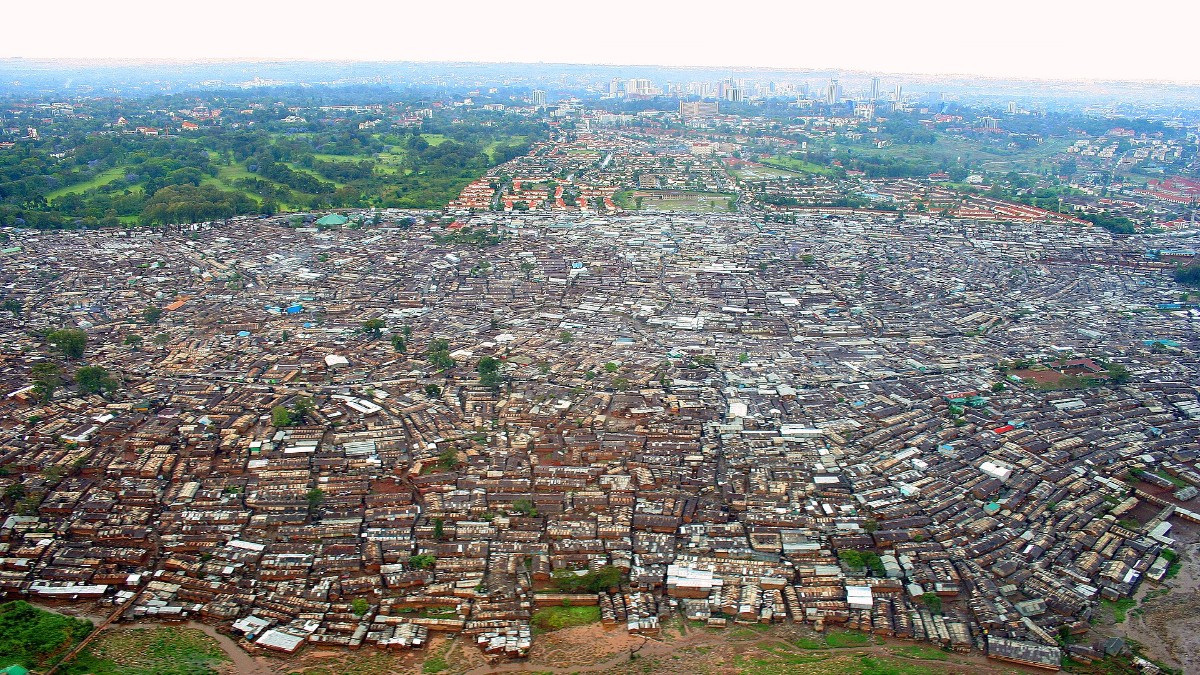
Photo: Schreibkraft / Wikimedia Commons, CC BY-SA 3.0
Listen to this article4 min listenAI voice
Tap play to hear this story
You are listening to Kibra News Network.
Over 4,000 Kibera families set to move into new Soweto East homes as Sh7.4bn project nears completion.
More than 4,000 Kibera households are edging closer to a set of keys and a formal address, with the Soweto East Zone B affordable housing project now past the 80 per cent completion mark.
The Sh7.4 billion development is being built on land that has shaped the story of Nairobi's best known informal settlement for generations. When finished it will hand over 4,054 units, ranging from single rooms through two-room homes to larger family units, an unusually broad mix intended to accommodate households of very different sizes and incomes.
A neighbourhood, not just a block of flats
The scheme has been designed as a functioning neighbourhood rather than a cluster of towers. Alongside the housing, contractors are putting up a primary school and a kindergarten, a health centre, commercial space for traders, recreational areas, boreholes to secure water supply, and flood-control works to tame the storm water that routinely swamps low-lying parts of the settlement. Officials say construction has so far generated more than 2,500 direct jobs, most of them filled by people living nearby.
Why Kibera is watching closely
President William Ruto has cast the programme as a way of restoring dignity to informal settlements, and the government has signalled that it intends to revive a stalled 900-unit Kenya Railways housing scheme on land in the same area. That would add significantly to the number of formal homes available in a part of the city where demand has always outstripped anything the state has delivered.
Enthusiasm on the ground, however, comes tempered by memory. Residents of Soweto East have lived through earlier rounds of slum-upgrading announcements that produced ceremonies, banners and very little brick. What is different this time is that the buildings are visibly there, rising in view of the households they are meant to serve. That has shifted the conversation away from whether the project will happen and towards a harder question: who ends up living in it.
What to watch next
The decisive issues from here are allocation and affordability – how units are assigned, what tenants or buyers will actually pay each month, and what safeguards exist to stop homes intended for Kibera families being flipped to better-off outsiders. The completion timetable for the remaining works, and whether the promised school, clinic and market space open at the same time as the flats rather than years later, will also determine whether Zone B is remembered as a genuine upgrade or as another partially delivered promise.
This story was put together by K N N from material first published by The Star & Citizen Digital.
That was a Kibra News Network report, read by an A I voice.
More than 4,000 Kibera households are edging closer to a set of keys and a formal address, with the Soweto East Zone B affordable housing project now past the 80 per cent completion mark.
The Sh7.4 billion development is being built on land that has shaped the story of Nairobi’s best known informal settlement for generations. When finished it will hand over 4,054 units, ranging from single rooms through two-room homes to larger family units, an unusually broad mix intended to accommodate households of very different sizes and incomes.
A neighbourhood, not just a block of flats
The scheme has been designed as a functioning neighbourhood rather than a cluster of towers. Alongside the housing, contractors are putting up a primary school and a kindergarten, a health centre, commercial space for traders, recreational areas, boreholes to secure water supply, and flood-control works to tame the storm water that routinely swamps low-lying parts of the settlement. Officials say construction has so far generated more than 2,500 direct jobs, most of them filled by people living nearby.
Why Kibera is watching closely
President William Ruto has cast the programme as a way of restoring dignity to informal settlements, and the government has signalled that it intends to revive a stalled 900-unit Kenya Railways housing scheme on land in the same area. That would add significantly to the number of formal homes available in a part of the city where demand has always outstripped anything the state has delivered.
Enthusiasm on the ground, however, comes tempered by memory. Residents of Soweto East have lived through earlier rounds of slum-upgrading announcements that produced ceremonies, banners and very little brick. What is different this time is that the buildings are visibly there, rising in view of the households they are meant to serve. That has shifted the conversation away from whether the project will happen and towards a harder question: who ends up living in it.
What to watch next
The decisive issues from here are allocation and affordability — how units are assigned, what tenants or buyers will actually pay each month, and what safeguards exist to stop homes intended for Kibera families being flipped to better-off outsiders. The completion timetable for the remaining works, and whether the promised school, clinic and market space open at the same time as the flats rather than years later, will also determine whether Zone B is remembered as a genuine upgrade or as another partially delivered promise.
Source: The Star (28 April 2026) & Citizen Digital.
KNN Newsroom is the staff byline for stories written, rewritten and edited at the Kibra News Network desk. Where a story credits an outside outlet, the original source is linked at the foot of the piece.