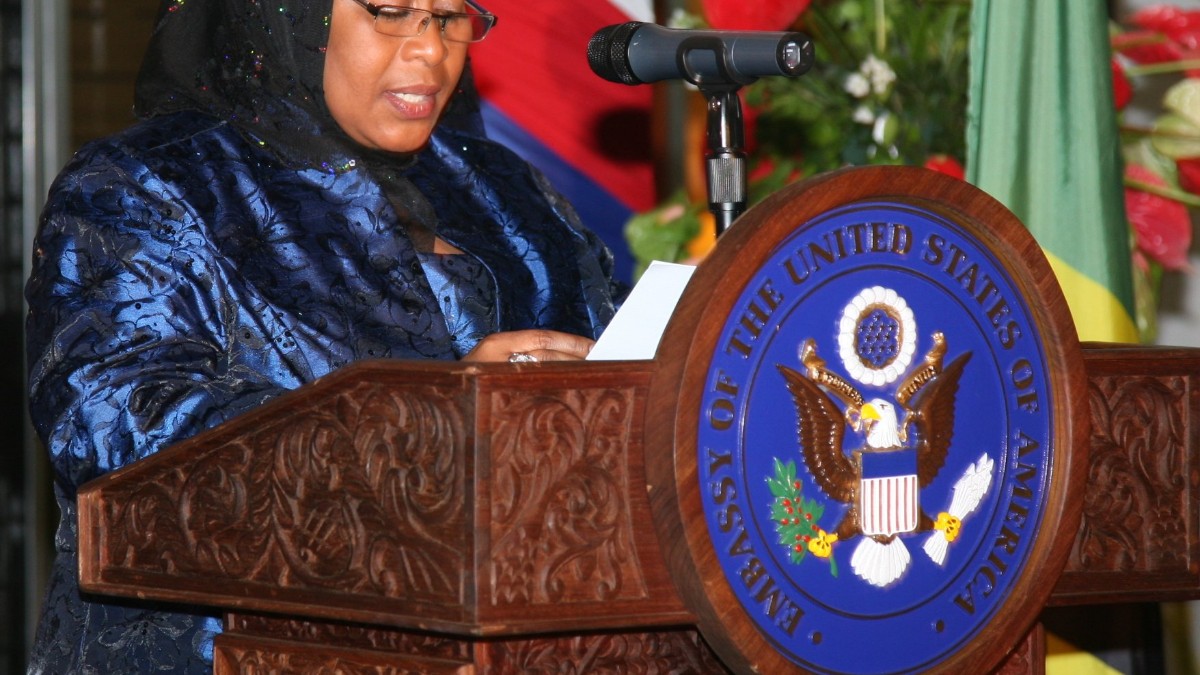
Photo: Embassy of the United States, Dar es Salaam, Tanzania / Wikimedia Commons, Public domain
Listen to this article2 min listenAI voice
Tap play to hear this story
You are listening to Kibra News Network.
Tanzania’s Samia Suluhu Hassan wins disputed vote as post-election crackdown draws condemnation.
Tanzania's President Samia Suluhu Hassan was declared winner of the country's election with roughly 98% of the vote and sworn in for a second term, in a poll that neighbours and rights groups have viewed with deep unease. Her ruling CCM party's overwhelming margin came after the main opposition, CHADEMA, was barred from the race and its leader, Tundu Lissu, was detained on treason charges.
The vote and its aftermath were marred by an internet blackout, a curfew in Dar es Salaam and allegations from the opposition of hundreds of deaths during protest crackdowns. Human Rights Watch later described the period as a "missed opportunity" to confront election violence and hold perpetrators accountable.
For Kenya and the wider East African Community, events in Tanzania carry direct significance: the two economies are closely linked, and instability or democratic backsliding across the border reverberates through trade, security and regional politics. As Tanzania settles into another CCM term, the questions raised about its democratic trajectory are unlikely to fade quietly.
This story was put together by K N N from material first published by Al Jazeera & Human Rights Watch (5 May 2.
That was a Kibra News Network report, read by an A I voice.
Tanzania’s President Samia Suluhu Hassan was declared winner of the country’s election with roughly 98% of the vote and sworn in for a second term, in a poll that neighbours and rights groups have viewed with deep unease. Her ruling CCM party’s overwhelming margin came after the main opposition, CHADEMA, was barred from the race and its leader, Tundu Lissu, was detained on treason charges.
The vote and its aftermath were marred by an internet blackout, a curfew in Dar es Salaam and allegations from the opposition of hundreds of deaths during protest crackdowns. Human Rights Watch later described the period as a “missed opportunity” to confront election violence and hold perpetrators accountable.
For Kenya and the wider East African Community, events in Tanzania carry direct significance: the two economies are closely linked, and instability or democratic backsliding across the border reverberates through trade, security and regional politics. As Tanzania settles into another CCM term, the questions raised about its democratic trajectory are unlikely to fade quietly.
Source: Al Jazeera (November 2025) & Human Rights Watch (5 May 2026).
KNN Newsroom is the staff byline for stories written, rewritten and edited at the Kibra News Network desk. Where a story credits an outside outlet, the original source is linked at the foot of the piece.