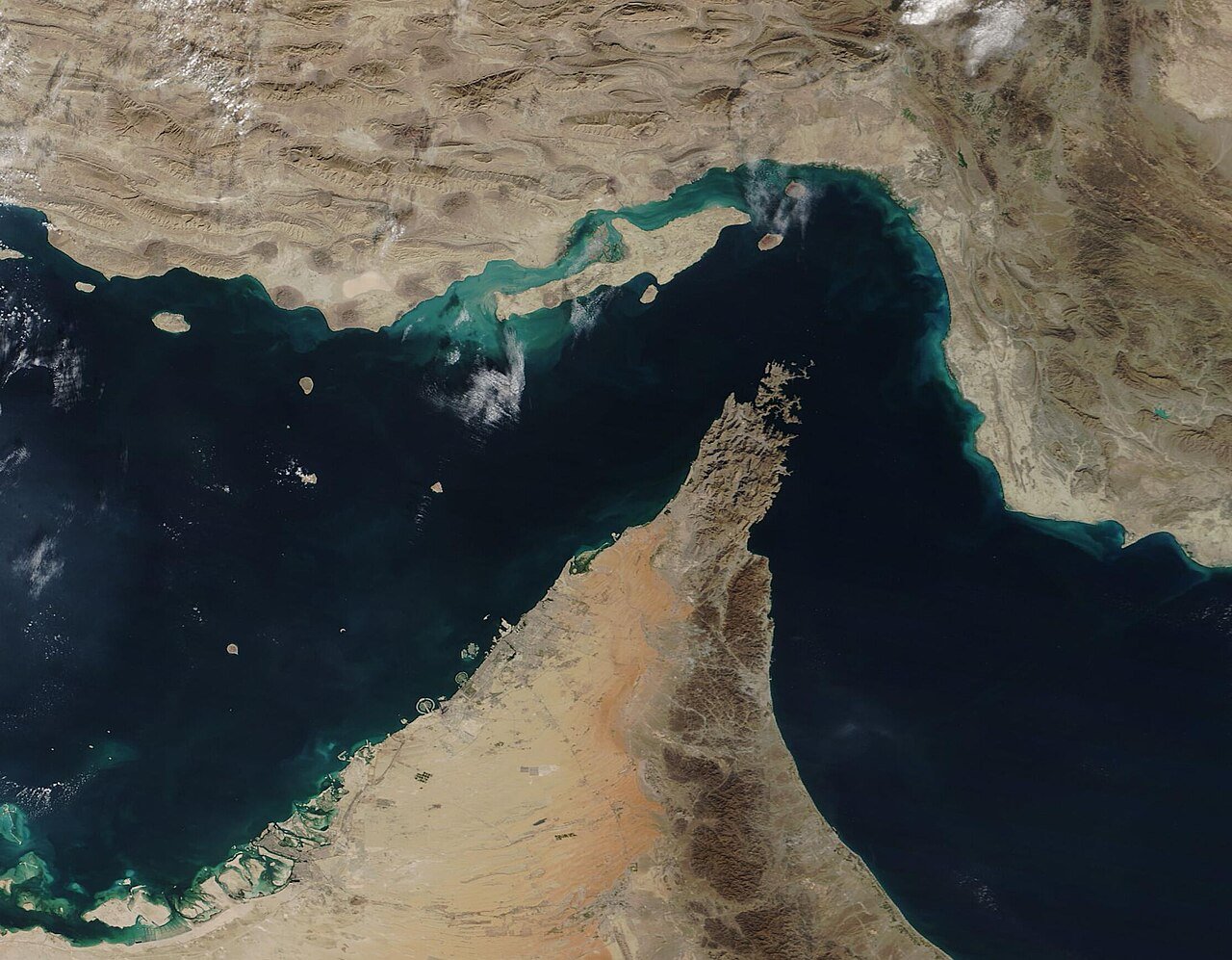
The Strait of Hormuz from space. Image: NASA MODIS (public domain)
Listen to this article3 min listenAI voice
Tap play to hear this story
You are listening to Kibra News Network.
US strikes southern Iran; Tehran fires missiles at Gulf bases.
The United States carried out dozens of strikes along Iran's southern coast on Tuesday, 1 September 2026, and Iran responded early on Wednesday with missiles and drones aimed at US-linked bases in Jordan, Bahrain, Kuwait and Iraq. It is the heaviest exchange in more than a month, ending a lull in the war that began on 28 February.
US Central Command said it hit Revolutionary Guard air-defence, radar, maritime, mine-laying and communications sites at Sirik, Konarak, Bandar Abbas, Jask, Asaluyeh and Qeshm Island, as well as sites in Khuzestan province.
Iran said one strike hit a wedding at a home in Kuhestak, Hormozgan province. Iranian state media reported four dead there, including two children, and dozens wounded; a provincial official reported seven more deaths in Khuzestan. Iran's health minister later put the overall toll at 18 dead and 108 wounded. The figures could not be independently verified.
Iran's response
Iran's Revolutionary Guard fired ballistic missiles and drones at Camp Titin near Jordan's Gulf of Aqaba, Prince Hassan airbase in Jordan, Sheikh Isa airbase in Bahrain, Ali Al Salem airbase in Kuwait and Erbil in Iraq. Jordan said it intercepted 10 of 13 missiles, with the rest landing in remote areas. Kuwait and Bahrain reported no casualties.
US President Donald Trump said the US had "almost total control of the Hormuz Strait" and warned Iran would be hit "much harder" if it retaliated. Iran's Foreign Ministry spokesman Esmaeil Baghaei said Iran "will respond to these savage crimes with firmness".
Why Kenya should watch
Brent crude rose to about USD 95 a barrel, up roughly 30 per cent since the war began. Higher crude prices feed directly into the fuel prices EPRA sets each month, and into the cost of transport and food. A June ceasefire memorandum expired on 17 August; Pakistan is continuing to mediate.
Sources: Al Jazeera; Al Jazeera explainer; NPR
That was a Kibra News Network report, read by an A I voice.
The United States carried out dozens of strikes along Iran’s southern coast on Tuesday, 1 September 2026, and Iran responded early on Wednesday with missiles and drones aimed at US-linked bases in Jordan, Bahrain, Kuwait and Iraq. It is the heaviest exchange in more than a month, ending a lull in the war that began on 28 February.
US Central Command said it hit Revolutionary Guard air-defence, radar, maritime, mine-laying and communications sites at Sirik, Konarak, Bandar Abbas, Jask, Asaluyeh and Qeshm Island, as well as sites in Khuzestan province.
Iran said one strike hit a wedding at a home in Kuhestak, Hormozgan province. Iranian state media reported four dead there, including two children, and dozens wounded; a provincial official reported seven more deaths in Khuzestan. Iran’s health minister later put the overall toll at 18 dead and 108 wounded. The figures could not be independently verified.
Iran’s response
Iran’s Revolutionary Guard fired ballistic missiles and drones at Camp Titin near Jordan’s Gulf of Aqaba, Prince Hassan airbase in Jordan, Sheikh Isa airbase in Bahrain, Ali Al Salem airbase in Kuwait and Erbil in Iraq. Jordan said it intercepted 10 of 13 missiles, with the rest landing in remote areas. Kuwait and Bahrain reported no casualties.
US President Donald Trump said the US had “almost total control of the Hormuz Strait” and warned Iran would be hit “much harder” if it retaliated. Iran’s Foreign Ministry spokesman Esmaeil Baghaei said Iran “will respond to these savage crimes with firmness”.
Why Kenya should watch
Brent crude rose to about USD 95 a barrel, up roughly 30 per cent since the war began. Higher crude prices feed directly into the fuel prices EPRA sets each month, and into the cost of transport and food. A June ceasefire memorandum expired on 17 August; Pakistan is continuing to mediate.
KNN Newsroom is the staff byline for stories written, rewritten and edited at the Kibra News Network desk. Where a story credits an outside outlet, the original source is linked at the foot of the piece.